The History of Magic by Chris Gosden
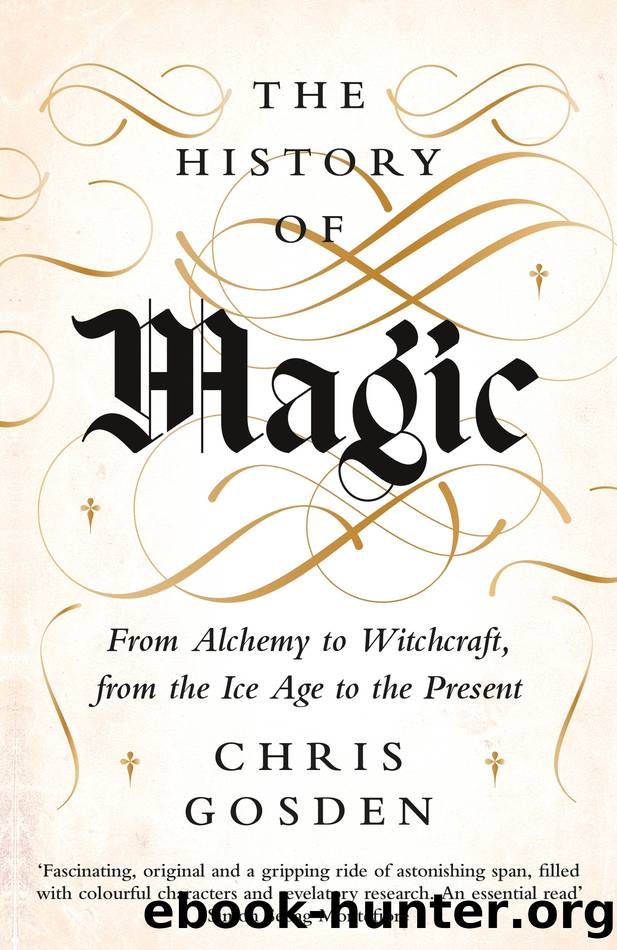
Author:Chris Gosden [Gosden, Chris]
Language: eng
Format: epub, pdf
ISBN: 9780241979655
Publisher: Penguin Books Ltd
Published: 2020-05-02T00:00:00+00:00
7. Jewish, Greek and Roman Magic (c. 1000 BCEâ1000 CE)
The idea of miracles has complicated the relationship between magic and religion for at least 3,000 years. Within Jewish and Arabic traditions, religious figures from Moses to Jesus and Muhammed worked miracles, which became a basis for their power, feeding then into Christianity and Islam. Meanings of the word âmiracleâ range between the wondrous and the unbelievable, containing always the notion that a miracle goes beyond the normal workings of the world, deriving from the influence of some divine or magical power. Moses, the prophets Elijah and Elisha, as well as Jesus and Muhammed, all performed miracles of similar types: they exorcised demons, healed the sick and raised the dead, confounded their enemies in various ways and caused dramatic changes in the physical world, such as parting seas or walking on them, and making foul water fit to drink. Individual miraculous acts arose from long cultural histories in the Middle East leading back to Mesopotamia and beyond; but they were now deployed to create belief in that cultural novelty, a single God.
Maybe some element of the older belief systems clung to miraculous acts, giving them ancient power in this new world. Much later, when Protestantism confronted Catholic Christianity, its major criticism was that the older Church was magical (as we will see in more detail in Chapter 9). Beliefs that substances could be transformed or given the power to protect people were thought illegitimate, perhaps associated with the energies of demons as much as with God. Early Modern negative evaluations of magic and miracles have made it harder to write histories of earlier periods in ways that show magic was often a positive quality and certainly a constant presence in Jewish, Greek and Roman life.
We last encountered the world of the Middle East and the eastern Mediterranean in Chapter 3. There we found in Mesopotamia and Egypt, between the fourth and second millennia BCE, a Bronze Age world of palaces and temples, of kings, pharaohs and priests, in which magic and religion were intertwined in a complex double helix and equally valued. Returning now to an Iron Age world of the first millennium BCE, we find much has changed: magic is still important, but it has been repositioned by new religious sensibilities (sometimes involving a single God), the growth of smaller ethnic groups between the big empires and, in Greece, the first steps in the slow development of the idea of a mechanical universe, as a more formalized science joined magic and religion in a triple helix.
Magic was accepted without exception by all strata of society, but its practice required considerable specialist magical knowledge; amateur dabbling with such powers was generally disastrous. In the official rhetoric of these times magic is a powerful but ambiguous quality, sometimes practised by specialists or charismatic individuals, and also by priests and rabbis drawing on religious lore. Magic is intimately bound up with religion for the Greeks and Romans, somewhat more removed for Jews. It
Download
This site does not store any files on its server. We only index and link to content provided by other sites. Please contact the content providers to delete copyright contents if any and email us, we'll remove relevant links or contents immediately.
| Africa | Americas |
| Arctic & Antarctica | Asia |
| Australia & Oceania | Europe |
| Middle East | Russia |
| United States | World |
| Ancient Civilizations | Military |
| Historical Study & Educational Resources |
The Dawn of Everything by David Graeber & David Wengrow(1707)
The Bomber Mafia by Malcolm Gladwell(1622)
Facing the Mountain by Daniel James Brown(1553)
Submerged Prehistory by Benjamin Jonathan; & Clive Bonsall & Catriona Pickard & Anders Fischer(1455)
Wandering in Strange Lands by Morgan Jerkins(1427)
Tip Top by Bill James(1416)
Driving While Brown: Sheriff Joe Arpaio Versus the Latino Resistance by Terry Greene Sterling & Jude Joffe-Block(1376)
Red Roulette : An Insider's Story of Wealth, Power, Corruption, and Vengeance in Today's China (9781982156176) by Shum Desmond(1359)
Evil Geniuses: The Unmaking of America: A Recent History by Kurt Andersen(1352)
The Way of Fire and Ice: The Living Tradition of Norse Paganism by Ryan Smith(1336)
American Kompromat by Craig Unger(1315)
F*cking History by The Captain(1303)
It Was All a Lie by Stuart Stevens;(1300)
American Dreams by Unknown(1285)
Treasure Islands: Tax Havens and the Men who Stole the World by Nicholas Shaxson(1272)
Evil Geniuses by Kurt Andersen(1257)
White House Inc. by Dan Alexander(1211)
The First Conspiracy by Brad Meltzer & Josh Mensch(1174)
The Fifteen Biggest Lies about the Economy: And Everything Else the Right Doesn't Want You to Know about Taxes, Jobs, and Corporate America by Joshua Holland(1126)
